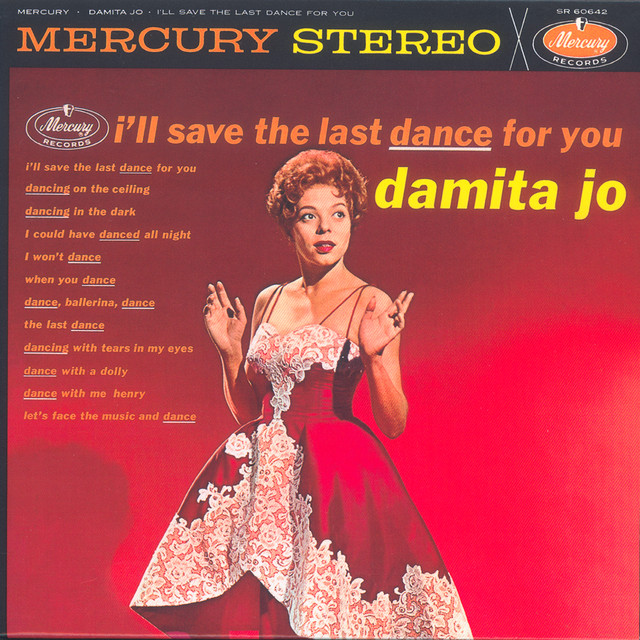

#75: DAMITA JO
"Dance With A Dolly (With A Hole In Her Stocking)"
from the album I'll Save The Last Dance For You
Released: January 1961
When
you feel like the old order needs to be overthrown so that the new one
can breathe, you quickly grasp reality from fake. Things sound new
and vaguely, exotically exciting in the middle distance, but you're
alert and recognise the signs of reactionism, of the old craving to keep
a finger in, or eye on, the new with a view to smothering it.
For
that reason I have eternally been suspicious of jolly, mass choral
backing vocals on pre-1963 pop songs. They strive so fervently to
reassure the ageing and afraid that they impede the thrust of anything
daring or even slightly off-centre. You see a grasp of squares, ladies
with ruffles and parasols and chaps with striped blazers and straw hats.
You detect tradition imposing a block on progress.
Alternatively,
you could choose to view this record as a dizzying sweep of pregnant
ecstasy. It is brisk and buoyant. Strings whirlpool down your audio
range in quasi-demented descants of transcendence. Drums eventually
remind us that these are their times. The lead singer is confident,
welcoming and, fuck it, happy. What's illegal about that?
There
is little actually new about the song, which had already been recorded
by the Andrews Sisters and Bill Haley's Comets and is in part based on a
traditional square dance number called "Buffalo Gals." Damita
Jo was already in her thirties and blameless - she inspired Janet
Jackson's middle names. It points to the future, Carlin you dumbo. Or at
least you would discern that more clearly if your face weren't loaded
up with intrusive, barking backing vocals which climax in a "whoa, whoa,
WHOA!" barely this side of Lawrence Welk comely conservatism. They
actually never shut up, and no doubt the record's arranger Stan
Applebaum intended them not to do so.
Why,
therefore, is this song one quarter of the way up this list? I came
across it one idle Sunday afternoon because I looked for something on
Spotify, played it and then let the random algorithm direct me to other,
less obvious things. These things happen; I played a song by Grace
Petrie and was eventually led into the hitherto unknown world of Belgian
sixties skiffle (Ferre Grignard's grinding re-reading of "Drunken Sailor"). Yet the positioning of the Damita Jo song indicates that I've
kept going back to it.
And the reason why I have, if I am honest with myself - and what is the point of this fucking book if I am not honest? - is because, actually, I like it.
Actually, scrub that "actually," stinking as it does of publisher
compromise. It is cheesy, banal and cheerfully obstructive. But it makes
me feel good, as the "naff" or "uncool" stuff frequently makes me feel.
I play it far more frequently than certain cod liver oil "classics"
that the ruling classes demand I "like" or at least "respect." And that
goes for Gerry Monroe, Russ Abbot and many other pullovered phenomena
largely loved by the working class.
So
why can't I just admit this? It's because we music writers - most of
us, anyway - nurture an absence of life. We don't live life; we aren't
equipped to negotiate its benign landmines. We realise very early on
that life as it is mainly lived has eluded us, for whatever biological
or psychological reason. Therefore, in order to avoid getting hurt, we
turn half away from life and view it through prematurely cynical armour
("A Knight In Rusty Armour" as Peter and Gordon once phrased it). Our
wall of snobbery is erected to protect ourselves from uprisings and
virulent overthrowings.
In
other words, we build this wall so solidly and impregnably that we miss
most of what life has to offer. If I were an ordinary person with an
ordinary interest in music - that is, it gets shifted to a background
role in our lives after the age of eighteen, to paraphrase what Tim Rice
once wrote in a Guinness Book Of Hit Singles preface (oh come back,
will you?) - then I'd enjoy things like "Dance With A Dolly" without
needing abstractedly to "justify" said enjoyment (I don't recognise the
chimera of "guilty pleasures," being neither a Catholic nor a
Protestant).
No, we have to find templates of excuses instead of giddily surrendering to
charm and happiness. You'll find disturbed online numpties arguing that
happiness is performative. Isn't every aspect of living as a human
being performative? Isn't living good enough for some people? But Jann
Wenner and his waspish chums in 1967 built such a wall, because how dare
ordinary people adore an art form that middle-class academics were
eager to seize and claim for their own!
And because of this preprogrammed obligation (to whom? to what?),
I am not permitted simply to enjoy "Dance With A Dolly." I am expected
to have my defences up, to be sneakily (albeit politely) dishonest about
what stimulates me in my life, thereby exposing the ultimate failure of
music criticism, which is to justify and prioritise failure at the
expense of fun, insolence, sex and, indeed, life. It isn't why I was
placed on this Earth.


No comments:
Post a Comment