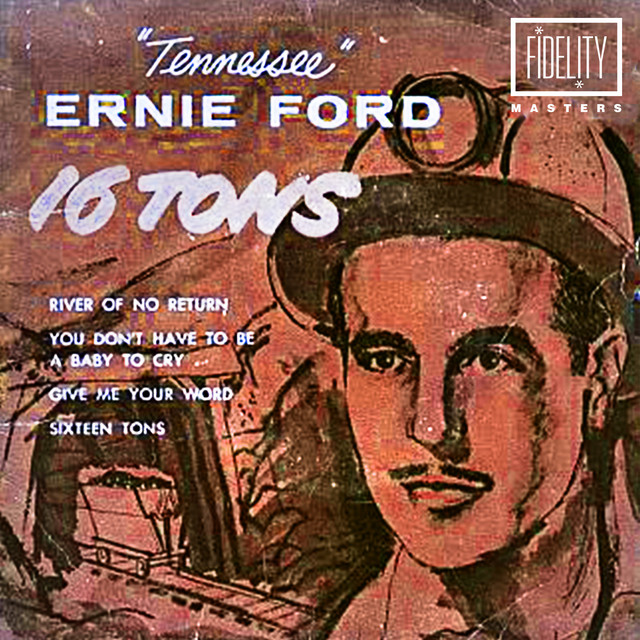
#86: TENNESSEE ERNIE FORD
"Sixteen Tons"
from the single "Sixteen Tons"
Released: October 1955
Capitalism
thrives on owning its consumers, principally the people who produce its
products. It continues to find ways of affirming that ownership but in
the 1940s those mainly took the form of the truck system, where
employees were paid not in money, but in kind, specifically credit
vouchers which were not transferable and could only be used to purchase
goods sold at the "company store." This clearly and intentionally made
it impossible for workers to have any savings in cash. In addition,
workers usually lived in houses or even dormitories owned by their
employer, who automatically deducted the rent from their salary and
could evict them if they raised even the merest of protests.
The
song "Sixteen Tons" resembled nothing else in the brightly melancholic
gleaming record charts at the time and that was intentional. It took the
form of a jazz shuffle, cleverly skirting around the seven-note Dies Irae
motif, over which emerges a warmly callous baritone voice. Warm because
you get the impression that he's not taking the song too seriously (the
chuckle midway through "And the
straw boss said, 'Well, a-bless my soul'"), callous because he is fully
aware of his power, indispensability and potential for fatality ("A lot
of men didn't...a lot of men died").
Yet
in the end this is a Pa Joad lament as the voice stretches "I owe my
soul" in a Robesonian fashion across several Mississippi syllabic deltas
before signing off with a quick "to the company store," who he knows
fundamentally don't mean shit. Remorseful clarinets suggest a "Avinu
Malkeinu" backdrop. The continuous, subtly relentless finger snaps
could break the neck of the unwary. It is a genial cry against a system
which has robustly failed to be dismantled in the nearly seven decades
since its word became audible.
Or make that eight decades, because Merle Travis, who wrote and first recorded "Sixteen Tons" for his 1947 album Folk Songs Of The Hills,
knew Tennessee Ernie Ford well, having played guitar on his first album.
Ford performed the song on his daily NBC television show throughout
1955 to great reaction and received a standing ovation for it at that
year's Indiana State Fair. The song's sentiments had been based on
feelings expressed in letters written by Travis' brother and father.
Recorded in haste as a B-side in September 1955 to fulfil a contractual
quota with Capitol, it was flipped, quietly exploded and sold twenty
million.
The
song was a immensely decisive "NO" to the new fifties consumerist
dream. It certainly penetrated deeply in the minds of the Scottish
people of the period, including my father, and has tragically not yet
passed into the past tense. Oh, and what put an end to this anti-culture
of debt bondage in the working class United States? The rise of unions.
And strikes.


No comments:
Post a Comment